
Human Albumin 20% Infusion 100ml: Uses, Composition, Administration, Safety and Supply Information
Introduction
Human Albumin 20% Infusion 100ml is a concentrated intravenous albumin preparation used in hospitals and specialized healthcare settings when albumin replacement or plasma volume support is clinically required. Human albumin is a naturally occurring protein present in blood plasma and plays an important role in maintaining oncotic pressure, circulating blood volume, and transport of various substances within the bloodstream.
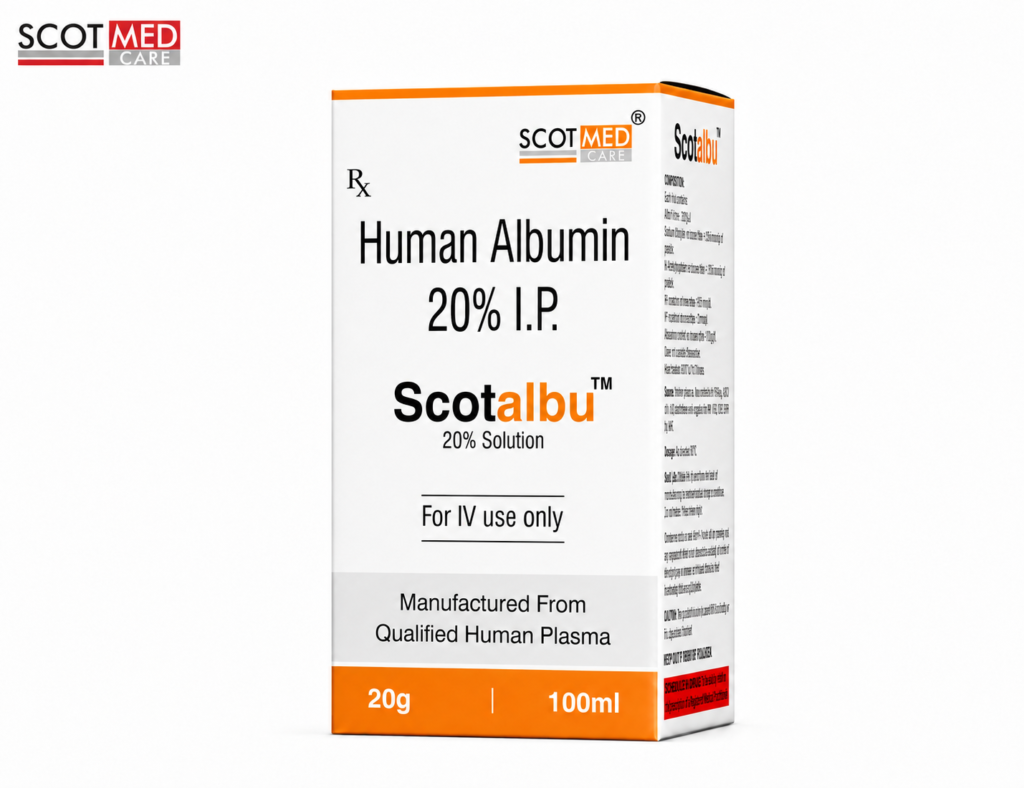
The product shown, SCOTALBU™ Human Albumin 20% I.P., contains a 20% human albumin solution, equivalent to approximately 20 g of albumin in a 100 ml container. It is manufactured from qualified human plasma and is intended for intravenous use only.
Because human albumin is a prescription biological product derived from human plasma, it should be administered only by appropriately qualified healthcare professionals according to the patient’s clinical condition and the prescribing information.
What Is Human Albumin 20% Infusion?
Human albumin is a purified preparation of albumin protein obtained from human plasma. Albumin is the most abundant protein found in normal human plasma and performs several important physiological functions.
A 20% albumin solution is considered a concentrated or hyperoncotic albumin preparation. It contains substantially more albumin protein per unit volume than lower-concentration preparations such as 4% or 5% albumin solutions.
Product Overview
Generic Name: Human Albumin
Strength: 20% I.P.
Dosage Form: Solution for intravenous infusion
Pack Size: 100 ml
Albumin Content: Approximately 20 g/100 ml
Route of Administration: Intravenous use only
Source: Qualified human plasma
Brand shown: SCOTALBU™
Category: Plasma-derived biological medicinal product
What Is Albumin and Why Is It Important?
Albumin is produced naturally by the liver and circulates throughout the bloodstream. It contributes significantly to the body’s ability to maintain an appropriate distribution of fluid between the blood vessels and surrounding tissues.
One of albumin’s principal functions is maintaining colloid oncotic pressure. This pressure helps retain fluid within blood vessels rather than allowing excessive fluid to move into surrounding tissues.
Albumin also acts as a carrier protein for numerous naturally occurring and administered substances.
It can bind and transport substances such as:
- Fatty acids
- Bilirubin
- Hormones
- Calcium
- Certain vitamins
- Various medicines and other compounds
For these reasons, albumin has both structural and transport-related functions within the circulatory system.
How Does Human Albumin 20% Work?
Human Albumin 20% produces a strong oncotic effect within the bloodstream.
When administered intravenously, albumin increases the concentration of circulating albumin and can draw fluid from the interstitial space into the vascular compartment. This may help increase circulating plasma volume when clinically appropriate.
Because the 20% preparation is concentrated, the volume administered can be relatively small compared with dilute albumin solutions while still providing a substantial quantity of albumin.
However, the response varies between patients. Doctors therefore determine the dose and infusion rate based on factors such as:
- Clinical condition
- Circulatory status
- Blood pressure
- Plasma volume
- Serum albumin level when relevant
- Cardiac function
- Renal function
- Fluid balance
- Electrolyte status
Treatment should be individualized rather than based solely on a laboratory albumin value.
Human Albumin 20% Infusion Uses
Human albumin solutions may be considered in a range of clinical situations where maintaining circulating volume, oncotic pressure, or albumin concentration is medically necessary.
The exact approved indications can vary according to the product’s prescribing information and local medical regulations.
1. Plasma Volume Support
Albumin may be used for plasma volume expansion in selected patients when a clinician determines that a colloid solution is appropriate.
Its oncotic properties help retain or recruit fluid into the intravascular circulation.
2. Hypoalbuminemia
Hypoalbuminemia means an abnormally low concentration of albumin in the blood.
Low albumin can occur in association with several serious medical conditions. In selected circumstances, physicians may prescribe albumin replacement when clinically justified.
It is important to understand that low serum albumin is often a consequence of an underlying illness, so treatment generally focuses on both the underlying condition and the patient’s overall clinical status.
3. Selected Liver-Related Clinical Situations
Patients with advanced liver disease can develop abnormalities involving fluid distribution and albumin levels.
Human albumin may be incorporated into specific treatment protocols for selected liver-related complications when recommended by a treating specialist.
The indication, concentration, dose and duration depend on the individual patient’s condition.
4. Selected Critical-Care Situations
Human albumin preparations may also be considered in certain critically ill patients when volume management requires a plasma-derived colloid.
Such decisions require careful assessment because fluid therapy must be individualized.
5. Other Specialist Clinical Applications
Albumin may be used in other specific hospital protocols where albumin replacement or oncotic support is considered clinically necessary.
These treatments require medical supervision and should follow current institutional protocols and prescribing information.
Why Is 20% Human Albumin Considered a Concentrated Preparation?
A 20% albumin solution contains approximately 20 grams of albumin per 100 ml.
Its higher concentration creates a substantial colloid osmotic effect while limiting the amount of infusion fluid required to deliver the protein.
This characteristic may be useful when physicians want albumin supplementation without administering a large volume of solution.
However, because of this strong oncotic effect, fluid status must be monitored carefully. Excessive or inappropriate administration can contribute to circulatory overload in susceptible patients.
Human Albumin 20% Infusion 100ml Composition
A typical 100 ml bottle of Human Albumin 20% solution provides approximately:
Human Albumin: 20 g per 100 ml
The product displayed is labeled as:
Human Albumin 20% I.P.
20% Solution
20 g | 100 ml
It is manufactured from qualified human plasma.
Exact excipients, electrolyte content, stabilizers and other formulation details should always be confirmed from the approved pack insert or product documentation supplied with the particular medicine.
How Is Human Albumin 20% Administered?
Human Albumin 20% is intended specifically for:
Intravenous administration
It should be administered by trained healthcare professionals.
The physician decides:
- Whether albumin is appropriate
- Required concentration
- Total dose
- Infusion rate
- Duration of therapy
- Whether additional fluids are necessary
- Required laboratory and clinical monitoring
The solution should not be self-administered.
Human Albumin Dosage
There is no single standard dose suitable for every patient.
The amount required depends on the patient’s clinical status rather than body weight or serum albumin level alone.
Doctors may assess parameters including:
- Blood pressure
- Pulse
- Urine output
- Circulating volume
- Electrolytes
- Hemoglobin and hematocrit
- Pulmonary status
- Cardiac function
- Serum albumin where appropriate
Treatment is adjusted based on clinical response.
Patients should therefore never use a generalized online dosage recommendation as a substitute for professional medical assessment.
Monitoring During Human Albumin Infusion
Patients receiving concentrated albumin therapy may require monitoring before, during and after administration.
Depending on the clinical condition, healthcare professionals may monitor:
Blood Pressure
Rapid changes in circulating volume may affect blood pressure.
Pulse Rate
Changes can help clinicians assess the patient’s circulatory response.
Urine Output
Urine production may provide information regarding renal perfusion and fluid status.
Electrolytes
Fluid shifts may affect electrolyte balance.
Hemoglobin and Hematocrit
Volume expansion can influence measured concentrations.
Respiratory Status
Difficulty breathing or evidence of pulmonary congestion requires prompt medical evaluation.
Cardiac Status
Patients with cardiovascular disease may require particularly careful volume management.
Precautions While Using Human Albumin 20%
Because concentrated albumin can influence intravascular volume, caution may be necessary in patients where increased circulating volume could create additional clinical risks.
Physicians may exercise particular caution in patients with conditions involving:
- Heart disease
- Significant hypertension
- Pulmonary edema
- Severe anemia
- Kidney impairment
- Reduced urine production
- Fluid overload
- Dehydration requiring additional fluid correction
The treating physician should evaluate the risks and benefits in each patient.
Possible Side Effects of Human Albumin Infusion
As with other medicinal products, human albumin can cause adverse reactions, although not every patient experiences them.
Possible reactions may include symptoms such as:
- Flushing
- Fever
- Chills
- Nausea
- Headache
- Changes in blood pressure
- Rapid heartbeat
- Skin reactions
- Breathing difficulty
- Allergic or hypersensitivity reactions
Severe reactions are uncommon but require immediate medical treatment.
Healthcare professionals should stop or modify the infusion according to the severity of any suspected reaction and follow the product’s prescribing information.
Risk of Circulatory Overload
One of the important considerations with concentrated albumin solutions is the potential for hypervolemia or circulatory overload when the administered quantity or infusion rate exceeds the patient’s capacity.
Possible warning signs may include:
- Shortness of breath
- Increasing blood pressure
- Pulmonary congestion
- Headache
- Distended neck veins
- Other signs of cardiovascular overload
Patients at increased risk require careful monitoring during infusion.
Human Plasma Safety and Manufacturing Controls
Human albumin is manufactured using human plasma obtained from qualified donors or plasma sources.
Plasma-derived medicinal products require extensive controls throughout sourcing, manufacturing, purification, testing and processing.
Manufacturers generally employ multiple approaches intended to minimize the risk associated with plasma-derived products, including:
- Careful selection of plasma sources.
- Screening and testing of donated plasma according to applicable requirements.
- Controlled manufacturing processes.
- Purification procedures.
- Validated pathogen reduction or inactivation steps where applicable.
- Quality-control testing of intermediate and finished products.
- Batch documentation and traceability.
Because it is a human plasma-derived biological product, manufacturing quality and regulatory compliance are particularly important.
Importance of Quality in Human Albumin Manufacturing
The manufacturing of human albumin differs significantly from conventional tablet or capsule production.
Human albumin requires specialized biological manufacturing capabilities involving sophisticated systems for:
- Plasma handling
- Fractionation
- Protein purification
- Viral safety processes
- Sterile filtration
- Aseptic processing
- Filling
- Quality testing
- Cold-chain or controlled-temperature management where specified
- Batch traceability
- Documentation
Every stage must be carefully controlled to maintain the intended purity, safety, stability and biological functionality of the albumin preparation.
Human Albumin 20% Storage
Storage requirements must always follow the instructions printed on the specific product carton and package insert.
Important general principles include:
- Keep the product in its original packaging until required.
- Maintain the temperature specified by the manufacturer.
- Protect from inappropriate heat or freezing if required by the labeling.
- Do not use a product after its expiry date.
- Examine the solution before administration according to the approved instructions.
- Do not use damaged or improperly stored containers.
- Once opened, handle according to the manufacturer’s instructions.
Healthcare institutions should maintain proper inventory and storage controls for plasma-derived medicinal products.
Human Albumin 20% vs Human Albumin 5%
One common question is how Human Albumin 20% differs from a lower concentration such as Human Albumin 5%.
| Feature | Human Albumin 20% | Human Albumin 5% |
|---|---|---|
| Albumin concentration | 20 g/100 ml | 5 g/100 ml |
| Type | Concentrated/hyperoncotic | More dilute |
| Albumin delivered per 100 ml | Higher | Lower |
| Fluid volume required for equivalent albumin amount | Lower | Higher |
| Clinical selection | Based on patient’s condition | Based on patient’s condition |
Neither concentration should automatically be considered “better.” The appropriate preparation depends on the therapeutic objective, volume status and overall clinical condition of the patient.
Why Human Albumin Requires Hospital or Professional Medical Supervision
Human albumin is not a general nutritional supplement.
It is an intravenous plasma-derived medicinal product used for specific clinical purposes.
Medical supervision is necessary because administration can significantly affect:
- Circulating blood volume
- Blood pressure
- Fluid balance
- Cardiac workload
- Pulmonary circulation
Healthcare professionals must determine whether the expected clinical benefit outweighs potential risks.
Human Albumin 20% Infusion 100ml for Institutional Requirements
Human Albumin 20% is predominantly required through regulated healthcare and pharmaceutical supply channels.
Potential institutional requirements may come from:
- Hospitals
- Critical-care centers
- Licensed pharmaceutical distributors
- Pharmaceutical companies
- Institutional procurement organizations
- Government or private healthcare institutions
- Authorized medicine suppliers
The purchase, stocking, distribution and administration of such products should comply with applicable pharmaceutical laws and licensing requirements.
Human Albumin 20% Supplier and Pharmaceutical Business Enquiries
For pharmaceutical companies and licensed institutional buyers, product sourcing involves much more than simply finding a low price.
Important factors when evaluating a Human Albumin 20% supplier include:
Product Quality
The product should comply with relevant quality specifications and applicable regulatory standards.
Reliable Supply
Hospitals and distributors often require continuity of supply and clear availability information.
Proper Storage
Plasma-derived products must be handled according to the storage conditions specified by the manufacturer.
Batch Traceability
Complete batch and distribution records are particularly important for biological products.
Documentation
Institutional procurement may require product-related regulatory and commercial documentation.
Professional Distribution
Products should be supplied only through legitimate and appropriately licensed channels.
SCOTALBU Human Albumin 20% I.P. 100ml
The product displayed is:
SCOTALBU™ Human Albumin 20% I.P.
Strength: 20%
Albumin Content: 20 g
Volume: 100 ml
Dosage Form: Solution for infusion
Route: For IV use only
Source: Manufactured from qualified human plasma
The pack is presented under Scotmed Care branding.
Product availability, commercial terms and regulatory documentation should be confirmed directly through the authorized supplier before procurement.
Frequently Asked Questions About Human Albumin 20% Infusion
What is Human Albumin 20%?
Human Albumin 20% is a concentrated sterile solution containing human albumin protein derived from plasma and intended for intravenous administration.
How much albumin is present in a 100ml bottle?
A 20% albumin solution generally contains approximately 20 g of albumin in 100 ml.
Is Human Albumin 20% given intravenously?
Yes. It is intended for intravenous use only and should be administered by qualified healthcare professionals.
Is Human Albumin a blood product?
It is a plasma-derived medicinal product manufactured from human plasma using specialized purification and manufacturing processes.
Is Human Albumin 20% the same as Human Albumin 5%?
No. They differ primarily in concentration. A 20% preparation contains four times the albumin concentration of a 5% preparation.
Can Human Albumin 20% be self-administered?
No. It is an intravenous prescription product that requires appropriate medical supervision.
Can Human Albumin be used simply because serum albumin is low?
Not necessarily. A low laboratory albumin result alone does not automatically determine treatment. Doctors assess the underlying cause, symptoms, volume status and overall clinical condition before deciding whether albumin therapy is appropriate.
Is Human Albumin 20% available in a 100ml pack?
Yes. Human Albumin 20% preparations are available in various presentations, including 20 g/100 ml, depending on the manufacturer and market.
What does “manufactured from qualified human plasma” mean?
It indicates that human plasma is used as the source material and undergoes defined qualification, processing, purification, testing and quality-control procedures according to applicable manufacturing requirements.
Importance of Responsible Use of Human Albumin
Human Albumin 20% can be an important therapeutic option in appropriately selected patients, but its use should always be clinically justified.
Responsible albumin therapy involves:
- Correct patient selection
- Appropriate concentration
- Individualized dosing
- Controlled infusion
- Monitoring of fluid status
- Assessment of treatment response
- Awareness of adverse reactions
- Use under medical supervision
The goal is not simply to increase a laboratory albumin value but to address a clearly defined clinical requirement.
Conclusion
Human Albumin 20% Infusion 100ml is a concentrated plasma-derived albumin preparation designed for intravenous administration in specific hospital and clinical situations. A 100 ml presentation provides approximately 20 g of human albumin, offering a high albumin concentration within a comparatively small infusion volume.
Albumin performs essential physiological functions, particularly in maintaining colloid oncotic pressure and circulating fluid balance. Human Albumin 20% may therefore be considered by physicians when albumin replacement, oncotic support or plasma volume management is medically appropriate.
Because the product has a significant effect on circulating volume and is derived from human plasma, its administration requires careful patient assessment, professional medical supervision and appropriate monitoring.
The SCOTALBU™ Human Albumin 20% I.P. 100ml pack shown is labeled as a 20% solution containing 20 g in 100 ml, manufactured from qualified human plasma and intended for IV use only.
For pharmaceutical companies, hospitals, licensed distributors and institutional buyers seeking Human Albumin 20% Infusion 100ml supply, product sourcing should focus on quality, regulatory compliance, appropriate storage, batch traceability and dependable pharmaceutical distribution.